

Startup Projects Team 27
October 16th 2026
The startup period for Ascend Team 27 is over, and Ascend's Technical groups have worked thoroughly with their startup projects. Each Technical group have used technology they learned through our courses during the onboarding period, and have acquired highly useful skills for the upcoming RoboWars and drone competition.
Autonomy's Startup Project
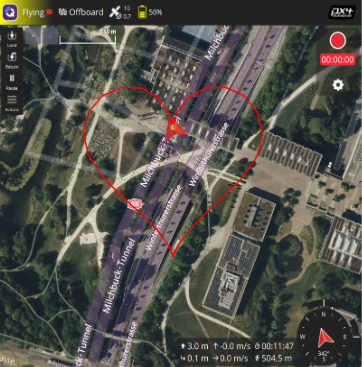
Autonomy's startup project focused on giving the members an introduction to the tools being used by Ascend, including getting hands-on experience with testing - both in simulation and in the real world. The project mainly covered ROS2, PX4, QGroundControl and Gazebo.
The task was to fly a drone autonomously in patterns, using waypoints generated by a separate script. To do this, we built a simple finite state machine (FSM) that distributed tasks to different ROS 2 nodes. This taught members about PX4's flight modes and how a drone is actually controlled autonomously through ROS 2 communicating with PX4.
The testing-plan consisted of testing all code in a simulation before flying. To make this possible, every member set up a simple Gazebo simulation on their own PC. In the end, the project was a success and the patterns were followed by the drones, as seen in the picture.
Perception's Startup Project
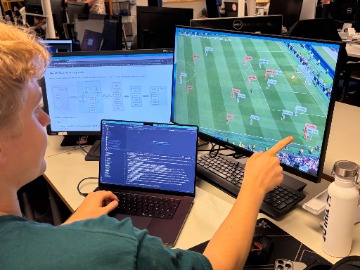
During the startup period, Perception worked on making a computer vision system for a football game. The group got a video file from a football match that only used one camera that continuously moved during the match. The goal was to map the 3D football field to a 2D perspective video with the football and all the players, with additional goals like recording passes, goals, possessions etc.. For this task the group was split in half.
One half focused on classic computer vision, and was responsible for the 3D to 2D mapping, where they used Python and the OpenCV2 library. OpenCV2 enables us to find good features/edges on the football field and also create image masks to separate the football field from its surroundings.
The other half of the group worked on detecting the football in play and the individual players. They mainly used pre-trained YOLO models, but also involved manually annotating images to improve existing models, the ball-tracking was especially improved by this, and they also tried to stack different models together with overlap and verification rounds. One whole session took about 12-14 hours to “render”.
Control's Startup Project
The Control team is the link between software and hardware. They are responsible for key areas, such as GNSS-positioning, flight stack, actuator solutions and code deployment. This means that we are the ones testing the drones and making them fly.
For our startup projects control has taken last years drones, and factory flashed them. Then our members has installed new software and configured them for flight. One of the software installed was ROS2 where our members were able to remotely communicate with the drones over WiFi. The final verdict was that one out of four drones flew, one drone ended up dancing and one drone performed backflips. Overall our members learned a lot from this experience which they will take with them into our R&D period.
Electrical's Startup Project
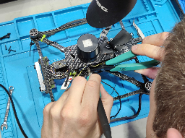
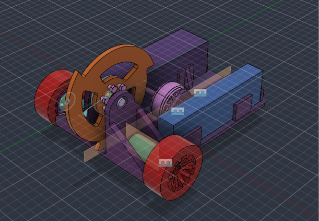
During the startup period, Electrical and Mechanical has been collaborating together working on a robot for the RoboWars Competition that are being held at Omega Verksted in October 24th 2026. As part of the project, the Electrical Team has designed the robot’s battery system and steering system, as well as developed the electronics required to control the robot using a radio controller.
Electrical is responsible for designing and developing the drone’s electrical system. This includes selecting motors and batteries, designing the power distribution system, and ensuring reliable power delivery to all onboard electronics. In addition, we design and manufacture custom PCBs tailored to the drone’s specific requirements.

Mechanical's Startup Project
The Mechanical Team is responsible for designing, manufacturing and sourcing the robot’s physical components. They have focused on the frame, weapon, wheels and armor. Most parts were developed through several design iterations and 3D printed in PLA, PA and PETG, while the weapon was manufactured by an external company.
We look forward to seeing Electrical and Mechanical competing in RoboWars in October 24th!
